
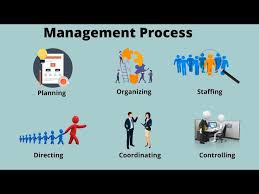
1.Planning
Definition:
Planning is the primary function of management. It involves determining in advance what is to be achieved, how it is to be achieved, and who will perform the tasks.

Features:
- Goal-oriented: Focused on achieving organisational objectives.
- Future-focused: Deals with future predictions and strategies.
- Continuous Process: Plans are revised as per changing conditions.
- Decision-making: Choosing the best alternative among several options.
Importance:
- Provides direction
- Reduces uncertainty
- Improves resource utilisation
- Minimises wasteful activities
Example: A business planning its annual sales targets.
2.Organising
Definition:
Organising is the process of identifying, grouping, and assigning activities to people, and allocating resources for achieving organisational goals.
Elements of Organising:
- Identification of activities
- Grouping of activities into departments
- Assignment of duties to individuals
- Delegation of authority and responsibility
- Establishing reporting relationships
Importance:
- Facilitates coordination
- Clarifies roles and responsibilities
- Promotes efficient use of resources
- Enhances managerial efficiency
Example: Creating departments such as HR, Finance, Operations, and Marketing.
3.Staffing
Definition:
Staffing involves acquiring, training, developing, and maintaining a competent workforce. It is also known as “Human Resource Management.
Steps in Staffing:
- Manpower Planning
- Recruitment
- Selection
- Training and Development
- Performance Appraisal
- Compensation and Promotion
Importance:
- Ensures competent employees
- Improves productivity
- Reduces labour turnover
- Promotes employee satisfaction
Example: Recruiting a qualified accountant for the finance department.
4.Directing
Definition:
Directing refers to guiding, supervising, motivating, and communicating with employees to achieve organisational goals.
Components of Directing:
- Leadership: Influencing people to work willingly.
- Motivation: Encouraging employees through monetary and non-monetary incentives.
- Communication: Exchange of ideas and information.
- Supervision: Ensuring work is performed as planned.
Importance:
- Improves employee performance
- Creates teamwork
- Maintains discipline
- Helps achieve organisational goals on time
Example: A manager motivating the sales team to achieve monthly targets.
5.Controlling
Definition:
Controlling is the process of monitoring performance, comparing it with standards, and taking corrective actions to ensure goals are met.
Steps in Controlling:
- Setting performance standards
- Measuring actual performance
- Comparing actual performance with standards
- Identifying deviations
- Taking corrective actions
Importance:
- Ensures efficient operations
- Minimises errors
- Maintains quality
- Helps in achieving goals effectively
Example: Comparing the monthly sales with the planned sales target and correcting deviations
Functions of Management
Introduction
Management is a systematic process of planning, organising, staffing, directing, and controlling the efforts of organisational members to achieve predetermined goals efficiently and effectively. These five functions are interconnected and together form the management cycle. Every organisation, whether small or large, profit or non-profit, must perform these functions to operate successfully.
The functions of management help managers to make decisions, utilise resources properly, guide employees, and ensure that organisational objectives are achieved within time and budget.
1. Planning
Meaning and Definition
Planning is the first and most important function of management. It involves deciding in advance what is to be done, how it is to be done, when it is to be done, and by whom it is to be done. Planning provides a clear roadmap for future actions and helps organisations face uncertainty confidently.
Definition:
Planning is the process of setting objectives and determining the best course of action to achieve them.
Without planning, business activities become random and directionless. Planning acts as the foundation of all other management functions.
Nature of Planning
Planning is goal-oriented, as it focuses on achieving organisational objectives. It is future-oriented, meaning it deals with forecasting and preparing for future situations. Planning is a continuous process because plans need regular review and modification according to changing business conditions. It also involves decision-making, as managers must choose the best alternative from various options.
Features of Planning
-
Goal-oriented activity
-
Forward-looking process
-
Continuous and dynamic
-
Involves decision-making
-
Basis of all other management functions
Importance of Planning
Planning provides direction to the organisation by clearly defining objectives and actions. It reduces uncertainty by preparing the organisation for future changes. Proper planning ensures optimum use of resources and avoids wastage. It also helps in coordination among departments and improves overall efficiency. Planning enables organisations to anticipate risks and develop contingency plans.
Importance of Planning
-
Provides clear direction
-
Reduces risk and uncertainty
-
Improves coordination
-
Ensures better utilisation of resources
-
Minimises wasteful activities
Example of Planning
A business organisation prepares an annual sales plan by forecasting demand, setting sales targets, deciding marketing strategies, and allocating budgets.
2. Organising
Meaning and Definition
Organising is the process of arranging tasks, resources, and people in a structured manner to achieve organisational goals. After planning what is to be done, organising focuses on how work will be divided and who will do it.
Definition:
Organising is the process of identifying and grouping activities, assigning duties, and establishing authority relationships.

Nature of Organising
Organising creates a formal structure of roles and responsibilities. It defines authority, responsibility, and accountability. Organising ensures that tasks are properly divided and coordinated. It also establishes relationships between superiors and subordinates to ensure smooth functioning.
Elements of Organising
-
Identification of activities
-
Grouping of activities into departments
-
Assignment of duties to individuals
-
Delegation of authority
-
Establishing reporting relationships
Importance of Organising
Organising ensures systematic allocation of work and avoids duplication of efforts. It promotes coordination among different departments and individuals. Proper organising clarifies roles and responsibilities, reducing confusion and conflict. It also improves managerial efficiency by enabling managers to focus on important tasks.
Importance of Organising
-
Facilitates coordination
-
Avoids duplication of work
-
Clarifies authority and responsibility
-
Promotes efficient use of resources
-
Improves managerial effectiveness
Example of Organising
An organisation creates separate departments such as Human Resources, Finance, Operations, and Marketing, with defined roles and reporting systems.
3. Staffing
Meaning and Definition
Staffing refers to the process of recruiting, selecting, training, developing, and maintaining a suitable workforce. It ensures that the organisation has the right people in the right jobs at the right time.
Definition:
Staffing is the managerial function concerned with hiring and developing employees to fill organisational positions.

Nature of Staffing
Staffing is a continuous process because employee needs change over time due to growth, retirement, promotion, or resignation. It focuses on both human and organisational development. Staffing ensures employee competence, motivation, and job satisfaction.
Steps in Staffing
-
Manpower planning
-
Recruitment
-
Selection
-
Training and development
-
Performance appraisal
-
Compensation and promotion
Importance of Staffing
Staffing ensures the availability of skilled and competent employees. Proper staffing increases productivity and quality of work. It reduces employee turnover and absenteeism. Effective staffing motivates employees and improves organisational performance. It also helps in achieving long-term organisational goals.
Importance of Staffing
-
Ensures competent workforce
-
Improves productivity
-
Reduces labour turnover
-
Enhances employee morale
-
Supports organisational growth
Example of Staffing
Recruiting a qualified and experienced accountant for the finance department and providing training on accounting software.
4. Directing
Meaning and Definition
Directing is the function of guiding, motivating, supervising, and communicating with employees so that they work efficiently towards organisational goals.
Definition:
Directing is the managerial function that initiates action by guiding and motivating employees.

Nature of Directing
Directing is a human-oriented function that deals directly with employees. It continues throughout the life of the organisation. Directing converts plans into action and ensures coordination among employees. It requires effective leadership and communication skills.
Components of Directing
-
Leadership
-
Motivation
-
Communication
-
Supervision
Importance of Directing
Directing improves employee performance by motivating them to work efficiently. It builds team spirit and coordination. Proper directing ensures discipline and effective communication. It helps employees understand their roles clearly and encourages them to achieve organisational objectives.
Importance of Directing
-
Improves employee performance
-
Encourages teamwork
-
Maintains discipline
-
Facilitates communication
-
Ensures achievement of goals
Example of Directing
A manager motivates the sales team through incentives and regular guidance to achieve monthly sales targets.
5. Controlling
Meaning and Definition
Controlling is the process of monitoring performance, comparing it with standards, and taking corrective actions when necessary.
Definition:
Controlling is the managerial function that ensures activities are performed according to plans.

Nature of Controlling
Controlling is both forward-looking and backward-looking. It helps in identifying deviations and correcting them. Controlling is a continuous process and is closely related to planning. Without controlling, plans cannot be effectively implemented.
Steps in Controlling
-
Setting performance standards
-
Measuring actual performance
-
Comparing performance with standards
-
Identifying deviations
-
Taking corrective action
Importance of Controlling
Controlling ensures efficient operations and quality standards. It helps in reducing costs and minimising errors. Controlling provides feedback for future planning. It ensures that organisational objectives are achieved on time.
Importance of Controlling
-
Ensures efficiency
-
Maintains quality
-
Reduces wastage
-
Detects deviations early
-
Supports goal achievement
Example of Controlling
Comparing actual monthly sales with planned targets and taking corrective measures if sales are below expectations