
ORGANISATIONAL STRUCTURES
Introduction
Every organisation, whether small or large, needs a proper system to divide work, assign responsibilities, coordinate activities, and achieve objectives efficiently. This system is known as organisational structure. Without a well-defined structure, confusion arises regarding authority, responsibility, communication, and decision-making. A good organisational structure helps in smooth functioning, better control, effective communication, and achievement of organisational goals.
An organisational structure clearly shows:
-
How tasks are divided
-
Who reports to whom
-
How authority and responsibility flow
-
How decisions are made
Management studies mainly focus on three basic organisational structures:
-
Line Organisation Structure
-
Functional Organisation Structure
-
Matrix Organisation Structure
Each structure has its own features, advantages, limitations, and suitability depending on the nature and size of the organisation.
1. LINE ORGANISATION STRUCTURE
Meaning
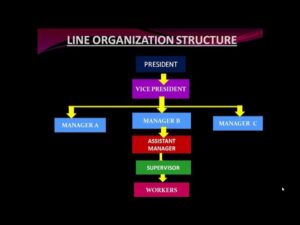
Line organisation is the oldest, simplest, and most traditional form of organisational structure. It is based on a direct vertical relationship between superior and subordinate. Authority flows from the top management to the lowest level in a straight line. Each employee is accountable to only one superior, following the principle of unity of command.
This structure is commonly found in small organisations and disciplined forces where clear authority and strict discipline are required.
-
Explanation
In line organisation, decision-making power is centralized at the top level, and instructions flow downward. Every department or section works under the direct supervision of one manager. Since there is only one chain of command, employees clearly understand their roles, duties, and reporting relationships. Communication is simple and direct, which helps in quick execution of work. However, the structure depends heavily on top management, which may result in overload and lack of specialization.
Features of Line Organisation
-
Clear chain of command
-
Authority flows vertically from top to bottom
-
Single boss for each employee
-
Centralized decision-making
-
Strict discipline and control
-
Vertical communication system
Advantages of Line Organisation
Line organisation offers simplicity and clarity, making it easy to establish and operate. Since authority is clearly defined, employees know exactly whom to approach for guidance and decisions. This leads to faster decision-making and strong managerial control. It is especially effective where routine work is performed and quick decisions are required.
Advantages
-
Simple and easy to understand
-
Quick decision-making
-
Clear authority and responsibility
-
Effective discipline
-
Strong control by top management
-
Economical to operate
Limitations of Line Organisation
Despite its simplicity, line organisation has several limitations. Top managers may become overburdened with work, as they are responsible for all decisions. Lack of specialization can reduce efficiency, as managers may not be experts in all areas. There is also a risk of autocratic leadership due to excessive authority concentrated at the top.
Limitations (Bullet Points)
-
Heavy workload on top executives
-
Lack of specialization
-
Limited scope for growth
-
Risk of dictatorship
-
Dependence on few individuals
Suitability of Line Organisation
-
Small businesses
-
Military and police organizations
-
Retail shops
-
Workshops with routine operations
-
Organisations requiring strict discipline
Example
A small manufacturing unit where the owner directly supervises workers and makes all decisions is a classic example of line organisation.
2. FUNCTIONAL ORGANISATION STRUCTURE
Meaning
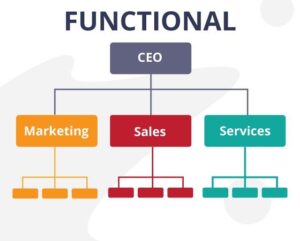
Functional organisation structure divides work based on functions or specializations. Each function is handled by an expert in that field. Authority is divided among functional heads such as Finance Manager, Marketing Manager, HR Manager, Production Manager, etc.
Unlike line organisation, employees may receive instructions from more than one superior, depending on the nature of the task.
Explanation
Functional organisation promotes specialization by grouping similar activities under one department. Each functional head is responsible for planning, organizing, and controlling activities related to their area of expertise. This structure improves efficiency, quality of work, and professional management. However, multiple authority relationships may create confusion and delays in decision-making if coordination is poor.
-
-
Main Functional Departments
-
Finance
-
Marketing
-
Human Resources
-
Production
-
Operations
-
Research & Development
Features of Functional Organisation
-
High degree of specialization
-
Functional experts as department heads
-
Authority divided by function
-
Multiple command system
-
Better efficiency and professionalism
Advantages of Functional Organisation
Functional organisation allows experts to manage their specialized areas, which improves work quality and productivity. It ensures better utilization of resources and encourages professional growth. This structure is suitable for large organisations where complexity and specialization are required.
Advantages
-
Encourages specialization
-
Higher efficiency and productivity
-
Better quality control
-
Reduced burden on top management
-
Suitable for large organisations
Limitations of Functional Organisation
The biggest drawback of functional organisation is violation of the unity of command principle. Employees may receive conflicting instructions from multiple functional managers, leading to confusion and stress. Coordination between departments can be slow, and departmental rivalry may affect overall organisational goals.
Limitations
-
Multiple bosses problem
-
Confusion in authority
-
Slow decision-making
-
Departmental conflicts
-
Weak discipline
Example
An airline company with separate departments for flight operations, engineering, finance, HR, and marketing follows functional organisation structure.
3. MATRIX ORGANISATION STRUCTURE
Meaning
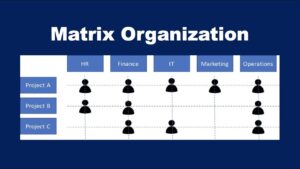
Matrix organisation is a combination of line and functional structures. In this structure, employees report to two superiors simultaneously:
-
Functional Manager (department-based)
-
Project Manager (project-based)
This structure is designed to achieve both specialization and flexibility.
-
-
Explanation
Matrix structure is commonly used in project-based and innovation-driven organisations. It allows efficient use of human resources by sharing employees across projects. Employees gain exposure to multiple areas and develop broader skills. However, managing dual authority requires strong communication and cooperation to avoid conflicts.
Features of Matrix Organisation
-
Dual authority system
-
Project-based teams
-
Resource sharing across departments
-
High coordination required
-
Flexible structure
Advantages of Matrix Organisation
Matrix organisation promotes efficient use of skilled manpower and encourages teamwork and innovation. It provides flexibility to respond to changing project needs and ensures faster completion of complex tasks. Employees gain diverse experience, enhancing learning and development.
Advantages
-
Better utilization of resources
-
High flexibility
-
Encourages innovation
-
Faster project completion
-
Improved coordination
Limitations of Matrix Organisation
The dual authority system may create confusion and conflicts between functional and project managers. It requires experienced managers and effective communication systems. The structure is complex and costly to maintain, making it unsuitable for small organisations.
Limitations
-
Two-boss problem
-
Power conflicts
-
Complex management
-
High administrative cost
-
Stress on employees
Suitability of Matrix Organisation
-
Aviation and drone industries
-
Technology companies
-
Consulting firms
-
Engineering and construction projects
-
Research & Development organisations
Example
A drone manufacturing company where engineers work under both the R&D head and specific project leaders uses a matrix structure.
Comparison of Organisational Structures (Summary)
Basis Line Functional Matrix Authority Single Multiple Dual Specialization Low High High Flexibility Low Medium High Complexity Simple Moderate Complex Suitable For Small firms Large firms Project-based firms -